Why Opening Up Is the Final Boss: The Nerd's Guide to Emotional Vulnerability in Dating

Half of all gamers are in relationships with non-gamers. Some of those relationships are great. Here's what separates the ones that work from the ones that don't.
You've cleared endgame content. You've memorized dialogue trees, theorycrafted builds at 2am, and navigated lore dense enough to bury a lesser player. But there's one mechanic you keep skipping — the one where you look at another human being and say something real about how you actually feel. That's the final boss. And unlike the others, it doesn't have a wiki entry.

This isn't a lecture about feelings. It's a breakdown of why emotional vulnerability is genuinely difficult for people wired the way we're wired — and why figuring it out is probably the most important quest you haven't started yet.
The Final Boss Nobody Warned You About
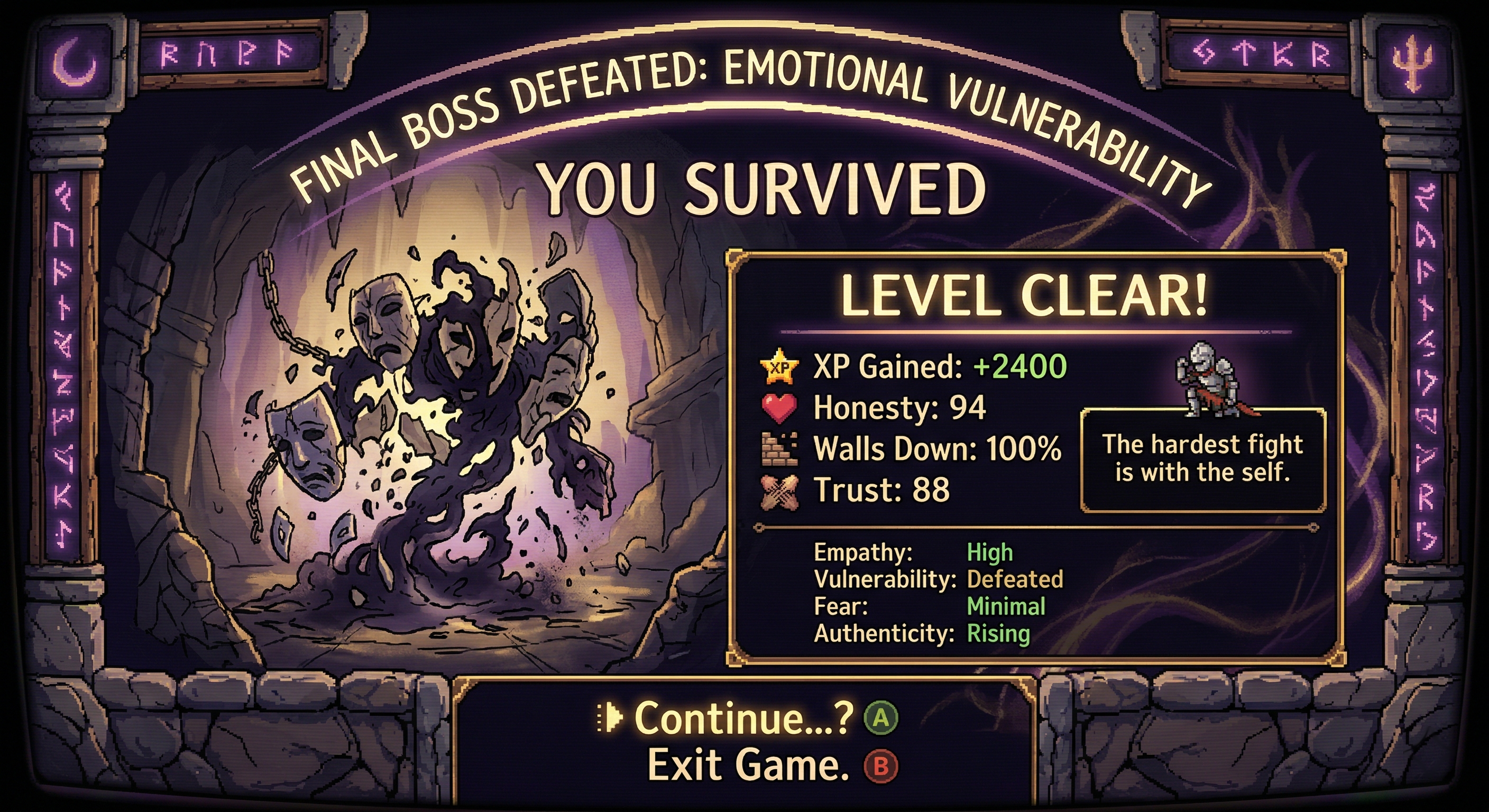
You Optimize Everything Except This
There's a specific kind of person who will spend forty hours routing an optimal playthrough but can't send a text that says "hey, I really like spending time with you." Who can hold a paragraph-length opinion about the failings of a fictional kingdom's power structure but goes completely silent when someone asks what they actually want in a relationship.
That's not a character flaw. It's a pattern — and it makes a lot of sense once you understand why it's there.
The skills that make someone great at games, great at systems thinking, great at deep-diving into fictional worlds — those skills were often developed precisely because the social and emotional landscape felt hostile or unpredictable. You get good at what's safe. And for a lot of nerds, feelings weren't safe. They were liabilities.
The Stats Don't Lie
Gallup's data is blunt about it: 25% of American men aged 15 to 34 report feeling profoundly lonely — higher than the national average, higher than any peer group in any other wealthy country. The U.S. Surgeon General declared an epidemic of loneliness in 2023. Roughly 52 million American adults report feeling lonely on any given day.
So if you've been sitting with the feeling that you're somehow uniquely bad at this — you're not alone in feeling alone. The data backs that up. What's less clear is how to actually do something about it.
Why the Vulnerability Check Keeps Failing
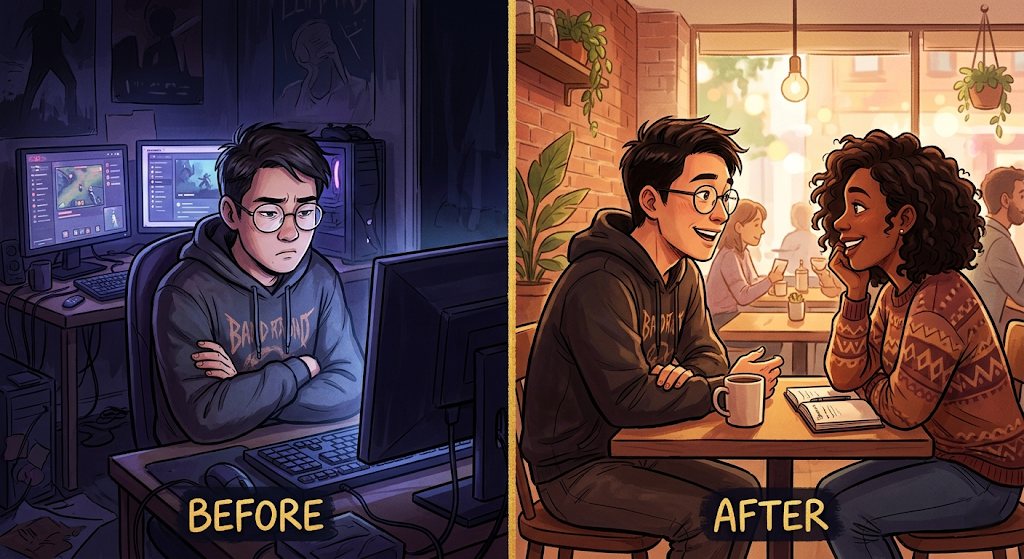
The Vocabulary Problem
Here's something researchers call alexithymia — difficulty identifying and expressing emotions. Clinically significant alexithymia affects roughly 10% of the general population. But men experience it at nearly twice the rate of women, and that's before you factor in what psychologists call "male normative alexithymia" — the culturally-trained version where expressing emotions was actively discouraged from boyhood onward.
This means a lot of nerdy guys aren't suppressing feelings they've identified. They genuinely struggle to name what they're experiencing. The feeling is real. The vocabulary isn't there. It's not avoidance — it's a skill gap. And skill gaps, unlike character flaws, can actually be trained.
The Gaming Factor
Here's the part that stings a little: the thing many of us love most has, in some ways, made this harder.
A 2023 systematic review in Frontiers in Psychiatry found that gaming is "frequently used as a coping mechanism during difficult life situations... as an avoidant, escapist strategy." A 2024 psychological profiling study found that about 20% of gamers show a distinctly avoidant emotional profile — characterized by difficulty regulating emotions and a tendency to escape from emotional stimuli rather than process them.
This isn't an indictment of gaming. Games are legitimately good for your brain in a dozen ways. But if gaming is your primary tool for emotional regulation — if every time things get complicated you just log in and disappear for six hours — you're not building emotional tolerance. You're avoiding building it. And the longer you avoid it, the bigger the boss gets.
The Armor Problem
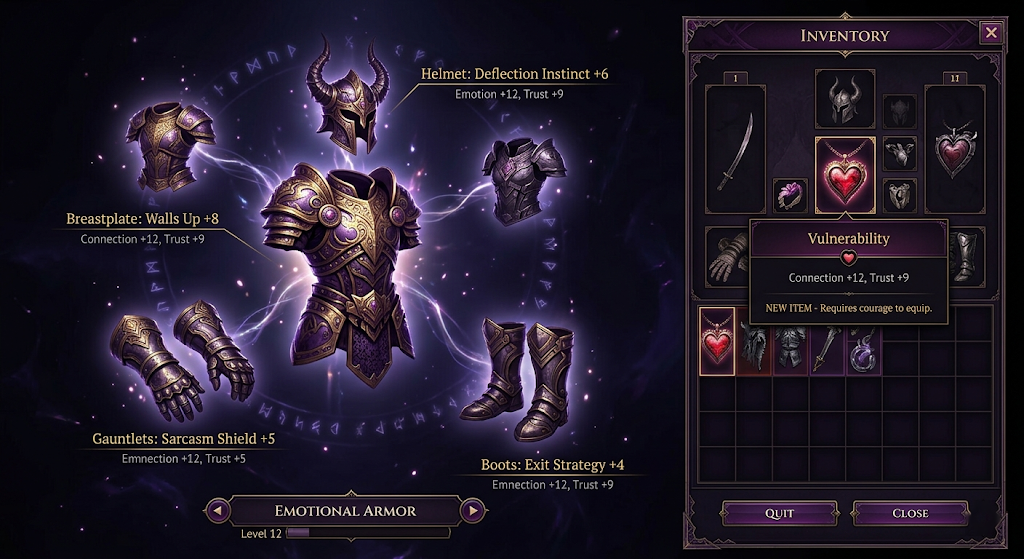
Brené Brown spent twelve years studying shame and vulnerability, and she identified something she calls emotional "armor" — the things we put on to avoid being seen. Irony. Sarcasm. Over-intellectualizing. Deflecting with humor. Hyper-independence, the "I don't need anything from anyone" stance that reads as cool but is actually just loneliness with a good build setup.
The armor works. Right up until you want to actually connect with someone — and then you realize you can't reach them through plate mail. Neither can they reach you.
What the Science Actually Says
The Birthplace of Connection
Brown's research kept finding the same thing: the people with the deepest relationships weren't luckier or better-looking or more charming. They went first. They believed they were worthy of connection before they had proof of it — which sounds obvious until you notice how many people are doing the opposite, waiting for certainty before risking anything real.
"Vulnerability," Brown writes, "is the birthplace of connection." Not a mood. A mechanism. The game doesn't load without it.
The 36 Questions and the Progression System
Psychologist Arthur Aron ran a study in 1997 that still gets cited constantly because it's that clean: pairs of strangers who completed 36 escalating personal questions reported dramatically higher closeness than pairs who just made small talk. The questions start shallow and go progressively deeper — surface preferences, then memories, then fears, then hopes.
Aron's key finding: "One key pattern associated with the development of a close relationship is sustained, escalating, reciprocal, personalistic self-disclosure."
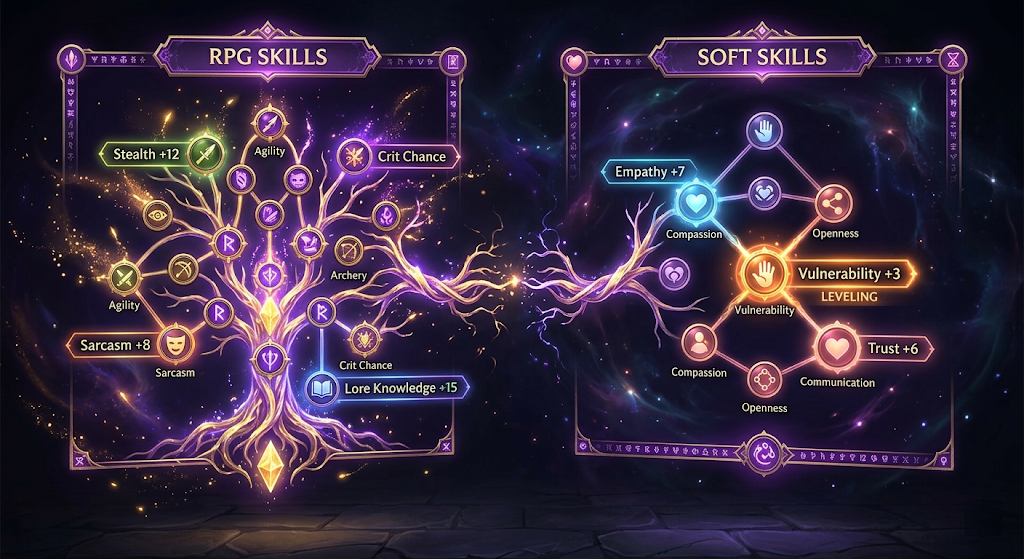
Translation for our purposes: vulnerability isn't a single boss encounter. It's a progression system. You don't dump your full character sheet on the first date. You share a little, they share a little, trust builds, depth unlocks. Back and forth. Gradual. Mutual. That's the mechanic.
Leveling Up: The Skill Tree for Opening Up

Level 1 — Name What You're Feeling
Before you can express an emotion, you have to be able to identify it. This sounds obvious until you try it and realize you've been running on vague uncomfortable static for years without ever labeling it.
The practice is simple and feels embarrassing at first: when something happens that has an emotional charge, stop and name it. Not "I'm fine" and not "I don't know." What is it actually? Frustrated? Disappointed? Anxious? Excited and terrified? There are apps built around this. There are therapists who specialize in it. There are also just sticky notes and five minutes of honest thought. Start there.
Level 2 — Share Something Low-Stakes First
The common mistake is treating vulnerability as binary — either full emotional disclosure or total lockdown. Neither of those builds intimacy. Aron's research is clear that gradual escalation is the mechanic that works.
Start small. Share a preference that actually matters to you. Mention something you're genuinely looking forward to. Admit to a mild fear. Let them see a real opinion, not a performance of one. You're not confessing secrets — you're testing the water, which is exactly what both people are doing in every early conversation that actually goes somewhere.
Level 3 — Tolerate the Response
The hardest part isn't opening up. It's staying present after you do. The impulse after saying something real is to immediately deflect, walk it back with a joke, or go quiet and wait to see if you've ruined everything. Resist all of those.
Let the response land. Sit with it. If it goes well, great — that's a trust point earned. If it's awkward, that's data, not disaster. You survived it. The window for connection is in that moment of not immediately retreating.
Level 4 — Repair When You Shut Down
You're going to shut down sometimes. Everyone does. The difference between people who eventually build real intimacy and people who don't isn't that the first group never closes off — it's that they come back and name what happened.
"Sorry, I went quiet — that question caught me off guard" is one of the most disarming sentences in the language of connection. It closes the gap. It signals that you noticed, that you care, and that the wall wasn't about them.
Boss Patterns to Watch For
Common Avoidance Builds
If you want to know what your particular armor looks like, here are the most common loadouts:
The Irony Shield: Everything is a bit. Nothing is sincere. Sincerity is cringe. This one's culturally reinforced across every online space that rewards wit over warmth, and it's genuinely hard to drop because it's been working for years in certain contexts. It's just not working here.
The Analyst's Plate: Intellectualize everything. Explain the psychology of your feelings rather than expressing them. Have fascinating opinions about your own emotional landscape without actually inhabiting it. Related: giving the Wikipedia summary of a trauma instead of just saying "that hurt."
The Self-Sufficient Stance: I don't need anything from anyone, I'm fine, I've got it handled. This is avoidant attachment in a trenchcoat. It reads as strength and is actually a strategy for never being disappointed — at the cost of never feeling held, either.
The Redirect: Every time a conversation dips below surface level, pivot to something safe. A fact, a joke, a question about their job. You become excellent at keeping things moving and never letting them slow down enough to go deep.
The goal isn't to obliterate these patterns. It's to notice them when they activate, and sometimes — not always, gradually — choose not to use them.
Why the Grind Is Worth It

What's Actually on the Other Side
This isn't a motivational speech. But it's worth saying plainly: the people in Brown's research who had the deepest connections, the most meaningful relationships, the most genuine sense of belonging — they didn't get there by being better looking or more charming or by finding the perfect partner. They got there by being willing to be seen.
The connection you've been looking for isn't on the other side of the perfect opening line or the ideal dating profile. It's on the other side of one real moment of showing someone something true about you, and having them not flinch.
That moment doesn't happen without risk. But it's a different kind of risk than you've been calculating. It's not about whether you'll fail — it's about whether you're willing to go first.
One More Thing
If the idea of practicing this in a space where the culture actually gets it sounds appealing, Dork Date's Guilds are built for exactly that — low-pressure community spaces where connection starts around shared interests rather than manufactured small talk, which makes the gradual-disclosure thing feel a lot less like a cold plunge.
But first: go name one thing you're actually feeling right now. That's Level 1. The rest follows.
— Rook Holloway