What Your Steam Library Says About Your Compatibility
Your Steam library isn't just a list of games — it's a personality test you didn't know you were taking. Here's what a stranger can read about you from your playtime, genres, and unfinished backlog.
Your Steam Library Is Already Talking About You
Every game you've ever bought, every hour you've logged, every achievement you've either hunted down obsessively or completely ignored — it's all sitting there in your Steam library, quietly building a profile on you. Not for Valve. For anyone who knows how to read it.
I've spent way too long staring at my own library (1,247 games, 304 played, yes I see the problem) thinking about what it actually says about me. And then I started looking at research. Turns out, personality psychologists have been studying the connection between game genre preferences and the Big Five personality traits for over a decade. The findings are genuinely interesting — not in a "your zodiac sign says you're compatible" way, but in an actual, peer-reviewed, reproducible way.
This isn't a personality quiz. This is more like: here's a lens that works, here's what the research actually says, and here's how to use it when you're trying to figure out if someone is worth a second date — or a co-op session, which might be the same thing.
The Genre Decoder Ring
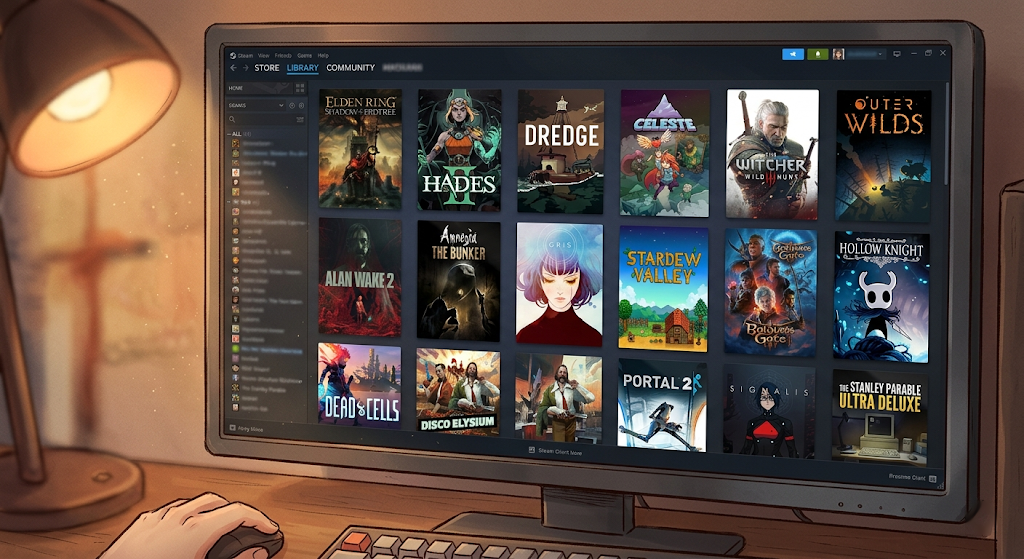
The clearest line in the research runs between genre preference and Big Five personality traits — particularly extraversion and conscientiousness.
A 2016 study by Braun et al. found that high extraversion combined with low neuroticism predicts a preference for action games — your FPS players, your fighting game mains, your people who think Dark Souls is a chill Friday night. A 2023 study in PMC's Children journal (Hasan et al., n=420) found that RPG genre preference specifically correlates with higher conscientiousness — the organized, goal-oriented, follow-through type. That same study confirmed significant relationships between RPG, combat, online, and music game genre preferences and multiple Big Five dimensions.
What does that mean in practice? A library stacked with strategy games, RPGs, and narrative-driven indie titles is probably sitting on a high openness, high conscientiousness person — someone who thinks before they act, who's genuinely curious about your inner world, who will actually remember the thing you mentioned three weeks ago. A library that's 80% competitive multiplayer shooters? Different profile. Not worse — just different. More stimulus-seeking, more externally focused, more likely to want to talk about the match they just played for forty-five minutes.
Horror deserves a mention here. The academic literature on horror-game personality is thin, but what exists connects to Zuckerman's sensation-seeking scale — horror game players tend to score high on sensation-seeking, a trait associated with openness to novel and intense experiences, risk-taking, and seeking out the emotionally complex. If someone's library is loaded with Amnesia, Outlast, and Visage, they are probably not low-drama people. That's not a warning. That's information.
The Backlog Doesn't Lie
Here's the number that broke my brain a little: according to Steam's Year in Review data analyzed by TechRadar in December 2024, only 15% of Steam users spent their total playtime on games released in 2024. The other 85% went to older titles. That means almost every Steam user has a backlog — a stack of unplayed or barely-touched games accumulating like digital dust.
The size and shape of someone's backlog is actually more psychologically revealing than their genre spread. Consider the profiles:
The 1,000-game library with 900 unplayed. This person bought everything on sale, said "I'll get to it," and almost certainly has seven other unfinished projects in their life too. Optimism bias — the genuine belief that future-you will have unlimited time and energy — is a real cognitive pattern. It's charming in some ways. It can also mean they start more things than they finish. Worth knowing.
The focused 60-game library, mostly completed. This person is deliberate. They chose what they own. They probably also have strong opinions about restaurants and will not be waffling when the waiter comes around. The conscientiousness signal here is pretty loud.
The deep-dive specialist. 400 hours in one game, scattered single-digit hours in everything else. This is the person who found their thing and went all the way in. Highly compatible with other depth-over-breadth people. Potentially frustrating if you're more of a sampler.
One honest caveat: Steam library size is partly a function of how long someone has had an account and how many Humble Bundles they've bought. A 1,000-game library might mean "I've had Steam since 2009 and I will never pass up a 95%-off bundle." Current playtime hours are more revealing than ownership numbers. Look at the hours, not the count.
Solo Mode vs. Multiplayer Mode
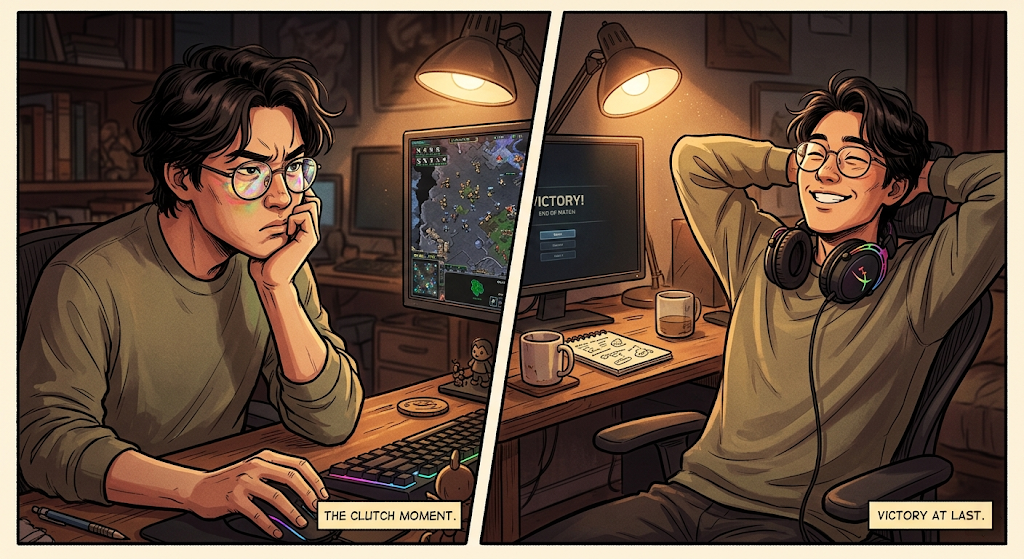
One of the most immediately readable things about a Steam library is the ratio of single-player to multiplayer titles — and more importantly, what they actually have hours in.
The extraversion–social gaming connection is well-documented. A 2014 ScienceDirect study on MMORPG behavior found that social PvE activities (grouping, raiding) positively correlated with extraversion, while solo achievement-hunting skewed lower-extraversion. According to MDPI's 2023 research, players with high extraversion demonstrate more combat aggression in games; conscientiousness is negatively related to in-game deaths — meaning careful, conscientious players literally die less.
But here's where it gets interesting: introversion and online multiplayer aren't mutually exclusive. A 2017 PubMed study by Reer and Krämer found that introverted players who engage in online social gaming — guilds, group play, community spaces — can actually gain social capital from it and use those connections as a bridge to real-world relationships. The person with 2,000 hours in WoW might be deeply introverted and have a rich, genuine social life built entirely through that game. Don't mistake "solo preference" for "antisocial." Sometimes it means "I decompress differently than you."
The compatibility angle here isn't "you both have to be multiplayer people." It's: do your recharge styles align, and can you both be okay when they don't? Someone who plays six hours of Stardew Valley alone to recover from a hard week needs that. Someone who immediately jumps into a Discord call to game with friends after a hard week needs that. Neither is wrong. But if you both expect the other person to match your mode, it's going to create friction that has nothing to do with the games.
The Completionist vs. The Beautiful Disaster
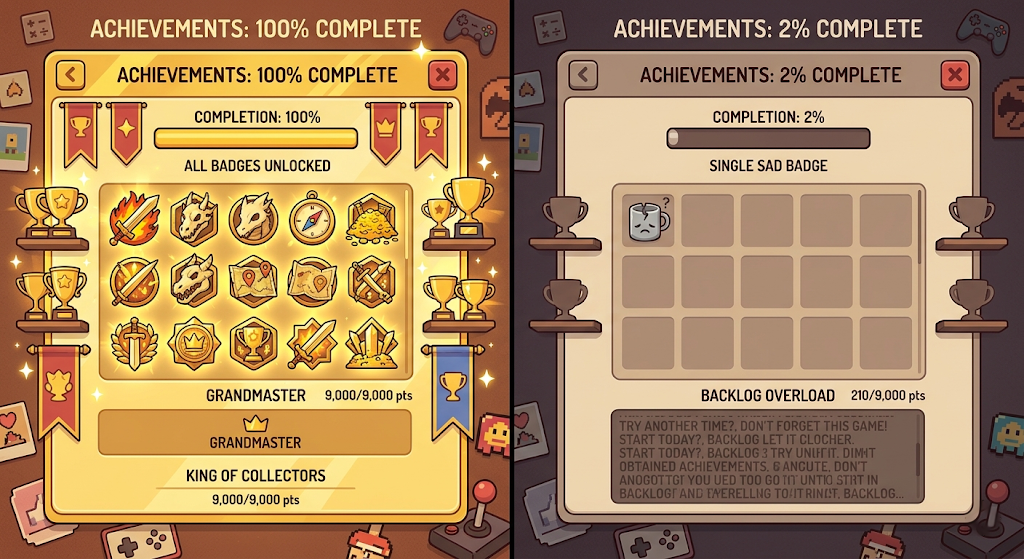
This one might be the clearest personality signal in the whole library.
Conscientiousness — the Big Five trait covering organization, goal-orientation, and follow-through — shows up plainly in how people finish games. The research links conscientiousness to prosocial in-game behaviors and careful play — a 2023 MDPI study found conscientiousness is negatively correlated with in-game deaths, meaning more careful, thoughtful play. Achievement hunters who push every game to 100% aren't just completionists; they're demonstrating a pattern of finishing what they start, tolerating repetition for a payoff, and finding satisfaction in closure.
If someone's achievement page is full of 100% completions, they probably show up when they say they will. That's not a small thing.
The chaotic dabbler — drops every game at 15-25%, has 47 games with "2 hours played" — isn't necessarily a red flag. It might mean they're a high-novelty person who gets bored once the new-thing feeling wears off. That's a real compatibility variable. Some people love the early phase of everything and struggle with the maintenance phase. In a relationship, that looks like a very exciting first three months followed by a quiet fade.
Again: this is a lens, not a verdict. Some of my favorite people have absolutely chaotic libraries. But it's data worth having.
Worth Knowing
A 2026 survey by Logitech G and Antenna Insights (n=1,500) found that couples who play video games together at least once a week report double the relationship satisfaction compared to couples who don't — and gaming couples log nearly 17 hours of quality time together each week. The co-op section of someone's library is a green flag. Whether they actually have hours in those co-op games is the better flag.
What It Actually Tells You About Compatibility
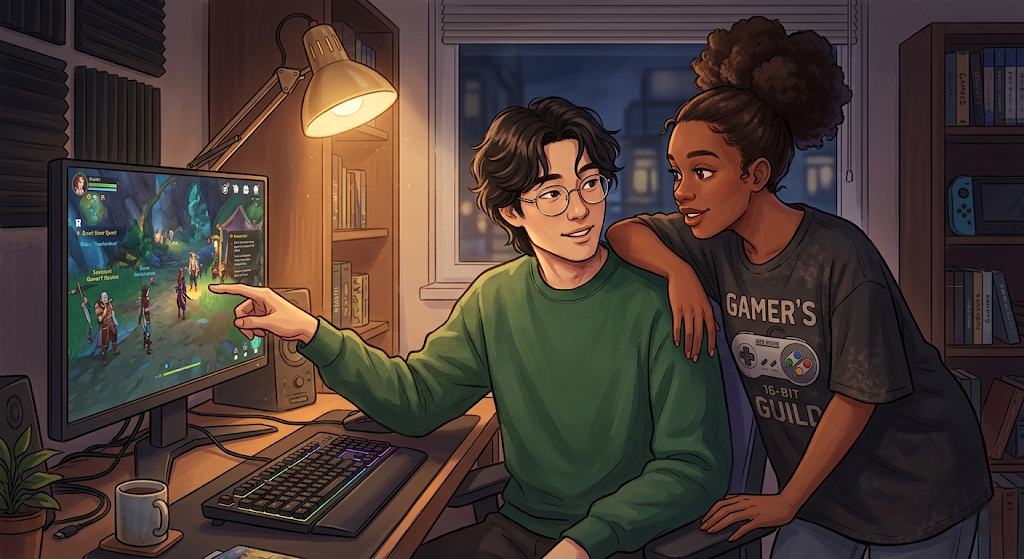
Let's be honest about what this is and isn't.
The personality-gaming research is mostly correlational, drawn from self-report surveys, and often conducted with college-age populations. Generalizing it to every adult Steam user is a stretch. What it gives you isn't a personality test — it's a conversation starter backed by plausible psychology. And sometimes a conversation starter is exactly what you need.
According to ESA's 2024 Essential Facts report (YouGov survey, n=5,000), 61% of Americans — 190.6 million people — play video games. The average gamer is now 36 years old. Gaming isn't a subculture identifier anymore; it's just something a lot of adults do. Which means a Steam library is no longer a niche data point. It's a lifestyle artifact, the same way a bookshelf or a Letterboxd profile is.
What a Steam library can legitimately tell you:
- How someone recharges (solo vs. social play tendencies)
- How they engage with ambition and follow-through (completionist vs. dabbler)
- What kind of experiences they seek out (depth vs. novelty, calm vs. high-stimulus)
- Whether they have co-op instincts at all — not just ownership, but actual hours
What it can't tell you: whether they're kind, whether they're honest, whether they'll still be interesting in two years. Genre preferences shift. A 2016 library is ancient history. Current playtime in the last six months is the better read.
And the research on couples who game together — even the Logitech G survey, which yes, was commissioned by a gaming hardware company — points at something that feels true independent of who funded it. Shared low-stakes time is relationship infrastructure. Co-op isn't a shortcut to compatibility. But it's a place to discover it.
Go Pull Up Their Profile
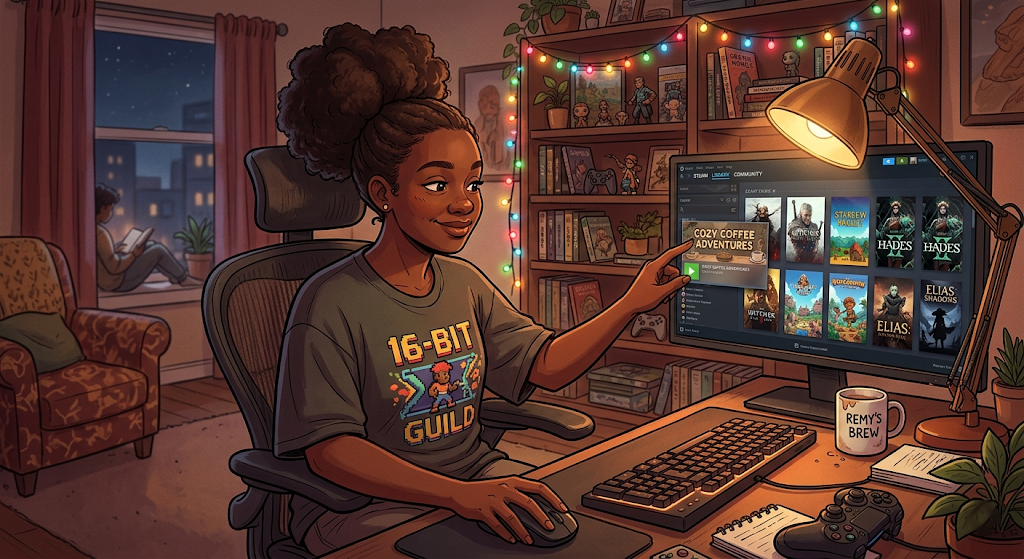
SteamDB has a library calculator. Profiles are public by default. You can see total hours, recent playtime, and game count in about thirty seconds. This isn't surveillance — it's the same thing as looking at someone's Goodreads before a first date. It tells you something real, and it gives you something to actually talk about.
Ask about the games they have the most hours in, not their favorites. Favorites are curated. Hours are honest. A person who says their favorite game is Disco Elysium but has 600 hours in Rocket League is telling you two things about themselves simultaneously, and both are worth knowing.
The best version of this isn't analysis — it's curiosity. You're not building a case. You're trying to understand how someone's mind works, what they find satisfying, how they spend the hours when nothing is expected of them. Games are a pretty clear answer to that question, if you know what to look for.
And if they have a co-op section with actual hours in it? That's a decent sign they've got room for someone else in their world.