From Server to Soulmate: How Online Gaming Communities Are Rewriting How Nerds Date
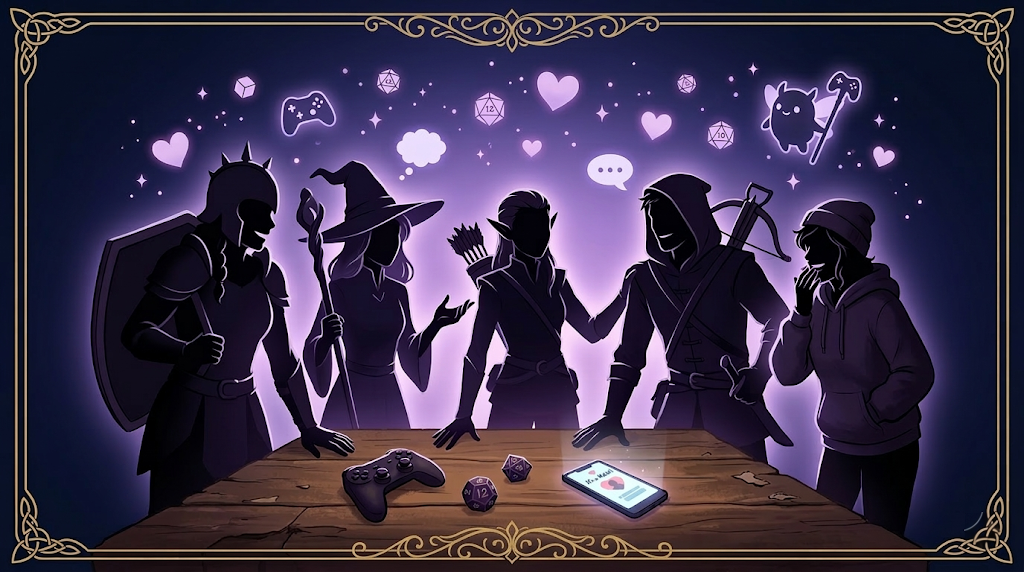
You didn't download a dating app. You joined a Discord server for that one game — and three months later, you're texting someone from your guild at 2 AM. This is the new nerd dating pipeline, and it quietly works better than anything Tinder has tried.
You didn't set out to find someone. You just joined a Discord server because you wanted people to do ranked matches with. Or you finally got into that MMORPG your coworker wouldn't shut up about. Or you found a guild that actually knows what it's doing. And then, somewhere between a dungeon wipe and a late-night voice chat about literally nothing, you started looking forward to seeing that one name online. This is the new nerd dating pipeline — and it's working better than anything Tinder has tried.
Why Most Dating Apps Miss the Point for Nerds
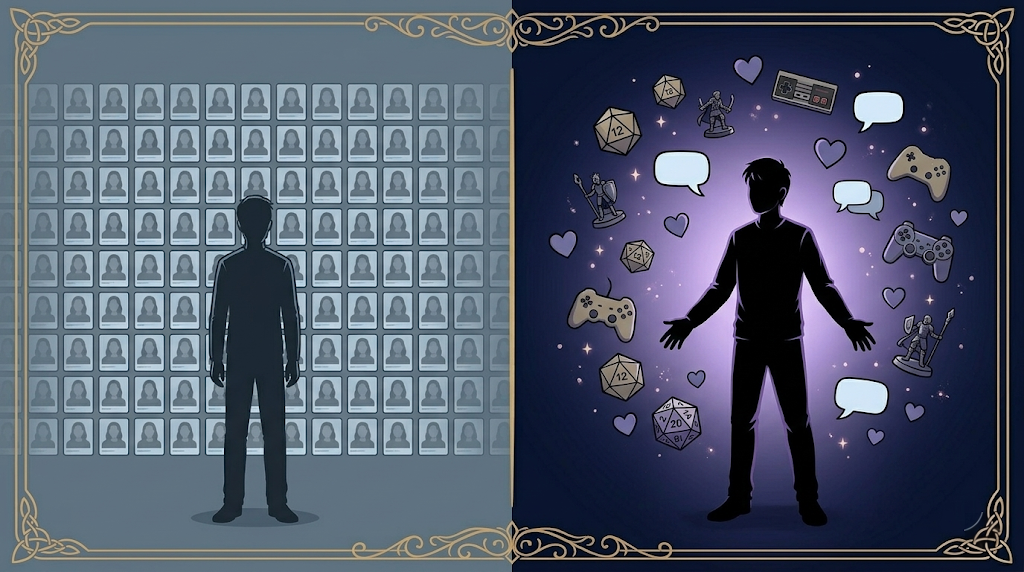
Dating apps are built around a fundamentally broken mechanic: judge a stranger on five photos and a bio in under three seconds. For the population of people who (a) don't photograph like influencers, (b) struggle to compress their personality into 300 characters, and (c) are not at their best when under pressure to be interesting on demand — dating apps are a terrible fit.
That population is, to a significant degree, gamers and nerds.
The Pew Research Center found that only about 10% of people in committed relationships actually met their partner on a dating app. Ten percent. For all the cultural weight apps like Tinder and Hinge carry, they're converting at single digits. And for introverts and nerds who already find the format uncomfortable, that number is almost certainly lower.
The Bio Problem
Dating app profiles reward people who are good at marketing themselves. Most nerds are not. They either undersell (a blank bio that just says "ask me") or oversell in ways that don't land outside the community ("I play DnD and watch anime" reads fine to someone who does the same; it reads as a warning flag to people who don't). The format punishes authenticity before you even get to a first message.
The Awkward First Message
Starting a conversation with a stranger based purely on physical attraction and a bio is a skill set most nerds haven't practiced or particularly want to practice. It's an unstructured social scenario with no shared context — no quest, no team, no objective to rally around. Pure, naked social performance. The sweat is practically audible.
That's exactly the gap Dork Date was built to fill. Instead of leading with profiles and swiping, it leads with Guilds — communities organized around the things you already care about, where you can meet people as people before you ever think about them as potential matches.
How Gaming Communities Build Real Bonds

Here's what nobody in the dating industry will tell you: you've probably already met the most compatible people you'll ever know. You just weren't looking for them that way.
Gaming communities create conditions for genuine connection that dating apps can't replicate, and the research backs this up.
Trust Through Shared Goals
Research on multiplayer online game dynamics consistently finds that collaborative gameplay builds real trust — not the polished, first-impression trust of a coffee date, but the kind of trust you earn by pulling your weight through a raid, calling out flanks when your team is down, or carrying someone through content they're stuck on. That trust transfers. It becomes the foundation of a real relationship.
The Mere Exposure Effect
Psychology has a phenomenon called the "mere exposure effect" — repeated interaction with the same person reliably increases how much you like them. Dating apps force you to manufacture chemistry cold. Gaming communities let it build naturally over weeks and months of just... hanging out. Playing together. Talking about nothing. The algorithm working in the background isn't a matching engine — it's time.
Personality Before Appearance
In a gaming community, you know who someone is before you know what they look like. You've seen how they handle pressure, how they treat lower-ranked teammates, whether they rage or stay composed after a loss, whether they share the carry when someone else needs the moment. This is character data that no dating app profile can provide. By the time you get to a photo, you've already decided you like the person.
A 2024 survey of 3,000 gamers by Gravastar found that 79% believe relationships formed through gaming are just as valid as those started in person or on dating apps. That's not a surprising stat to anyone who's watched it happen — it's just the community finally saying out loud what's been quietly true for years.
The Numbers: Gaming Communities Are Actually Working

The same Gravastar study found that 43% of gamers have developed romantic feelings for someone they met through online gaming. And 56% now view their gaming communities as legitimate potential dating pools — a number that has almost certainly grown as the pandemic-era habit of making real friends online became normalized.
Statista data from October 2023 shows that 82% of US gamers agree that playing video games helps them connect with others. That's not a niche phenomenon — that's the mainstream gamer experience. The connection isn't accidental. It's built into the structure of how these games work.
Not All Games Are Equal
The research does break down by genre in interesting ways. MMORPGs — your World of Warcrafts, your Final Fantasy XIV, your Guild Wars 2 — top the list, with 43% of gamers seeing them as the best environment for meeting partners. The logic tracks: you're investing hundreds of hours in the same world, on the same team, grinding the same goals. Casual and social games come in second at 30%. Co-op games at 15%.
Competitive Battle Royales? Only 11%. Turns out that screaming at strangers over a dropped loot box doesn't build the warmest emotional foundation. Who knew.
The Organic Pipeline: From Server Member to Something More

Here's how it actually happens, for the people it happens to.
You're in a server. You keep crossing paths with the same person — they're in the same voice channels, they respond to the same kinds of things, their humor lands exactly right for you. You start playing together deliberately. Then you're DMing outside the game. Then you're talking about things that have nothing to do with the game. Then you're looking forward to getting home so you can log on and see if they're online.
It doesn't feel like dating. That's exactly why it works.
Consider Yanina Remersaro and Scott Ellwanger, who met in Lord of the Rings Online — she was in Argentina, he was in Pennsylvania. Three years of questing together. Three years of building trust, shared jokes, and knowing each other's playstyles cold. At some point, she found herself missing him when he didn't log on. He had been thinking the same thing. She flew to Pennsylvania. They got engaged. They got married.
This is not a fairy tale. This is just what happens when you let the relationship build the right way, on foundations that actually matter.
The Invisible Audition
In a gaming community, you're constantly being yourself. Not your curated dating profile self. Your actual self — impatient, generous, sarcastic, loyal, whatever you are when you're relaxed and playing something you love. And the people in that community are responding to that. When someone develops feelings for the version of you that shows up in a guild or a Discord server, they're responding to the real thing. That's a different, more durable foundation than "you looked good in your third photo."
How to Actually Use Your Existing Communities
This isn't a "lower your standards and you'll find love" pep talk. It's practical: you already have assets. Use them.
Be a Consistent Presence
The mere exposure effect requires exposure. Show up in the same channels, participate in events, be someone people actually know. Not in a desperate way — in the way that someone who genuinely enjoys their community shows up. The difference is obvious and the latter is the only one that actually works.
Play With the Same People More Than Once
Random matchmaking doesn't build bonds. Finding someone you played well with and saying "want to run this again?" does. Most meaningful gaming connections started with someone noticing that a specific person made the game more fun and deliberately seeking them out again. This is not complicated. It's just intentional.
Let It Be Slow
The best version of this process has no urgency. You're not rushing to confess anything or declare intentions on a timeline. You're just building a friendship in an environment you both already inhabit. The romantic dimension develops or it doesn't, but the friendship is worth having either way. This patience — which is often hard on dating apps but easy in games — is what makes gaming relationships actually stick.
Take It Off-Server Eventually
There's a point where you have to meet the person. A voice call, a video chat, eventually a real-life meeting if things are developing. The transition can feel high-stakes after months of building something in the low-pressure gaming environment. It's okay for it to feel that way. You've already done the hard work — you know each other. The video call is just confirmation of what you've already established.
Where Dork Date Guilds Come In
Everything this post has been describing — the slow build, the shared context, personality before appearance, trust through repeated interaction — that's not a dating strategy. It's just what happens when people with common interests spend time together. The romantic part is almost incidental.
Dork Date Guilds are built around exactly that premise. A Guild isn't a swiping queue. It's a community organized around a fandom, a game, a genre, an obsession. When you join one, you're not being handed a stack of profiles to evaluate — you're joining a group of people who already share your interests. The matching layer exists, and profiles exist, but neither of those is the entry point.
You meet people through the Guild first. You see how they talk, what they care about, how they engage with the thing you both love. The same dynamics that make gaming communities work — repeated exposure, shared context, character before appearance — those are built into how Guilds function. If something develops, you already have a foundation. If it doesn't, you still found people worth knowing.
It's the gaming community pipeline, except purpose-built for people who want a slightly more intentional version of it. Or for people who don't already have a community to work with. Same mechanic. Different server.

You Already Have the Best Pipeline. You Just Haven't Been Calling It That.
The dating advice industry has conditioned people to think that finding a partner requires a platform purpose-built for finding partners. That's convenient for the platforms. It's not necessarily true.
The gamers who've found their people inside gaming communities — in guilds, Discord servers, co-op lobbies, game nights that extended into 3 AM conversations about literally everything — didn't use a special technique or follow a framework. They just kept showing up somewhere they already loved being, and eventually, someone in that same space became more than a name on a friends list.
Your communities are full of people who already share your interests, your humor, and your weird deep-cut references. Some of them are single. Some of them are wondering the same things you are. If you don't have that community yet — or you want a version where the context is a little more explicit — Dork Date Guilds are the place to start. The server is already running. Log in.