How to Tell If Someone Is Faking Their Nerd Credentials
You've met someone who claims to love gaming, anime, or D&D — but something feels off. Here's how to spot the difference between a slow-burn fan and someone who's just wearing the costume.
Something Feels Off
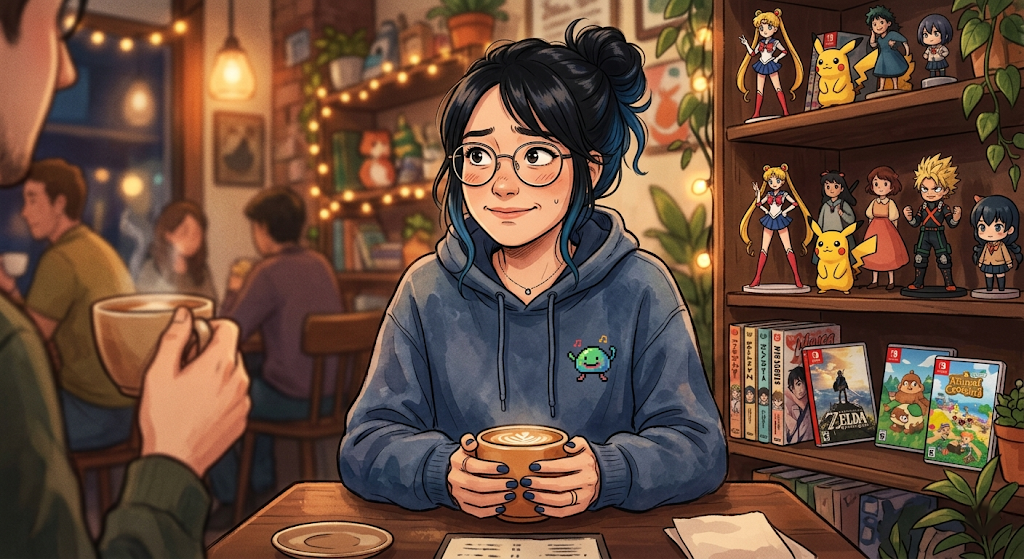
You matched with someone who listed Elden Ring in their profile. They said they love anime. They dropped a D&D reference in their opener that honestly landed pretty well. You thought: finally. Then you actually met them, started talking, and something just felt... wrong. Like watching a cover band — all the right moves, none of the soul.
Maybe they couldn't name their favorite FromSouls game. Maybe they went weirdly vague when you asked what they're currently watching. Maybe their enthusiasm tracked your enthusiasm a little too perfectly, like they were mirroring rather than connecting. You couldn't quite name it, but the vibe was off.
You're not imagining it. And you're not being a snob for noticing.
Here's the thing though — this isn't really about catching fakers and banishing them from nerd culture. It's about compatibility. Because there is a meaningful difference between someone who loves what you love and someone who's wearing it like a costume. And in dating, that difference matters a lot.
Why This Actually Matters (And Why It's Not Gatekeeping)
Let's get the obvious thing out of the way: the "fake geek girl" discourse from 2012 was largely a disaster — misogynistic, toxic, and mostly used to harass women who dared to exist in gaming spaces. Nobody needs to pass a trivia quiz to be allowed at the table. Full stop.
But underneath that mess is a real, separate concern — one that has nothing to do with policing who gets to be a nerd and everything to do with whether two people actually connect.
About 201 million Americans play video games. Nearly half of them are women. Anime, D&D, cosplay, comics — all of it has gone aggressively mainstream. A $25 billion Harry Potter franchise doesn't have a niche fanbase; it has everyone, from obsessive Potterheads to people who saw one movie at a sleepover in 2003 and haven't thought about it since. When your whole identity is built around something that's now everywhere, it gets genuinely harder to tell who shares your depth of passion versus who just absorbed it through cultural osmosis.
And that depth gap matters. According to a SolitaireBliss survey of over 1,000 gamers, about 29% say dating non-gamers is hard — and 40% of female gamers say it's even harder. In that same survey, 43% of respondents said non-gamer partners just don't understand their relationship with gaming. When you want to debate lore, celebrate a new release, or spend a Friday night in a raid instead of a bar, you need a partner who gets it — not one who's tolerating it.
That's not gatekeeping. That's compatibility. And it's worth paying attention to.
The Spectrum (Because It's Never Black and White)
Before we get into red and green flags, here's the thing nobody says enough: not all casual fans are faking. There's an actual spectrum here, and where someone falls on it matters more than whether they can recite the Silmarillion.
The Performer: This is the actual problem. They've adopted the label to attract you — or just to seem interesting — with no real engagement underneath. They're not growing into it. They just want the identity without the hobby. The tells are behavioral, not trivia-based.
The Casual Fan: Real interest, surface-level engagement. They've watched the popular stuff, played the mainstream games, like the thing genuinely — they're just not deep in it. This isn't a crime. Most people start here.
The Enthusiast: Real depth. Opinions. A backlog. An embarrassing amount of time logged in one franchise. This is where most self-described nerds live.
The Obsessive: Knows the lore beyond what's in any released media. Has opinions about translation choices. Is personally offended by canon decisions. You know who you are.
The compatibility issue isn't Casual Fan dating an Obsessive — that can work, especially if there's mutual curiosity. The problem is when someone presents as an Enthusiast or Obsessive to attract a date, and turns out to be a Performer. That's where relationships built on shared nerd identity quietly fall apart.
The Red Flags (Behavioral, Not Trivia)
Here's the critical rule: don't quiz people. That's not a date, it's an oral exam, and it makes you the villain in the story. What you're looking for is behavior, not test scores. Authentic passion has textures that are hard to fake.
They can't name a favorite — or their favorites always match yours. Real fans have opinions. Specific, sometimes irrational ones. If they "love all video games" with equal enthusiasm and no preferences, that's a flag. If their favorite game somehow becomes whatever you just mentioned you love... that's a bigger flag.
Vague praise, no specifics. "I love anime so much" is easy to say. Ask what they're watching right now, what they abandoned, what they hated — and watch what happens. Genuine fans will have immediate, slightly chaotic answers. Performers go vague.
They deflect when you go deeper. This is the big one. A real fan lights up when someone goes deeper into the thing they love. A performer gets uncomfortable, changes the subject, or suddenly has somewhere to be. Find someone who goes deeper with you, not someone who backs away when you do.
No wear and tear. Real hobbies leave marks. A backlog of games they haven't finished. An anime they dropped halfway through because the pacing got bad. A D&D campaign that collapsed in a scheduling disaster. If their relationship with the hobby is frictionless and pristine, that's suspicious. Authentic engagement comes with failure, with unfinished things, with strong opinions about what didn't work.
They never initiate. Notice if they only talk about nerd stuff when you bring it up. Real enthusiasm is hard to contain — it spills out unprompted. If theirs only appears reactively, ask yourself what's driving it.
Their references are all surface-level entry points. The movie, not the comics. The mainstream game, not anything from the same developer. The popular character, not the lore around them. This can just mean someone is new to the hobby — which is fine — but paired with the other flags, it tells a story.
The Green Flags (What Real Passion Actually Looks Like)
You want someone whose nerd identity has a lived-in quality — like a well-worn save file, not a fresh install.
They have opinions you didn't expect — including negative ones. Real fans are discriminating. They'll tell you which arc of the manga ruined the series for them. They'll have a complicated relationship with a game they love. They'll defend the Star Wars prequels with more passion than the originals. The specific takes matter less than the fact that they have takes.
They have a history with the hobby. Not just "I've always loved gaming" — they remember the first game they played obsessively, the year they fell down an anime rabbit hole, the moment they realized they were a nerd and leaned into it. That kind of narrative is hard to fake on the fly.
They get excited when you go deep. Test this. Drop a piece of lore that isn't common knowledge. Ask a question that goes past the surface. Someone who genuinely loves the thing will lean in. This is the single clearest signal.
They know the stuff adjacent to their main thing. Fans of a genre tend to absorb the culture around it — other titles, related genres, community jokes, ongoing discourse. If their knowledge forms a web rather than a single island, that's real.
They make references unprompted, in casual context. Real enthusiasm bleeds into everyday life. They'll see something and immediately think of a game. They'll compare a life situation to a plot they love. This isn't performance — it's just how people's brains work when they genuinely love something.
This is also where platforms like Dork Date's Guilds quietly do the heavy lifting — when you spend time in a community built around your specific thing, you end up meeting people whose nerd identity is visible in how they engage, not just what they list in a profile. Real fans act like real fans in a community, before they're even trying to impress anyone.
The Nuanced Case: Slow-Burn Fans Are Real (And Worth Your Time)
Here's the part that matters and that most articles on this topic completely skip: everyone starts somewhere.
Some of the most genuine nerds you'll ever meet are people who discovered their thing late. Maybe they never had access to the culture growing up. Maybe they were introduced to it by someone they loved. Maybe they just happened to pick up the right game at the right time and fell completely in. Being new to something doesn't make you a fake — it makes you a newcomer.
The difference between a slow-burn fan and a performer comes down to one thing: curiosity vs. mimicry.
A slow-burn fan asks questions. They want to know where to start, what to watch next, what your take on the lore is. They don't pretend to know things they don't. Their enthusiasm is about learning and discovering — not performing. They're building something real, just from a different starting point than you.
A performer doesn't ask questions, because asking questions would reveal that they don't know things. They generate plausible-sounding responses and hope you don't dig too deep. Their enthusiasm turns off when there's no audience for it.
The one you want to date — the slow-burn fan — is rare and underrated. They'll probably catch up to your depth faster than you expect, and they'll do it with genuine enthusiasm because the discovery is real for them.
The test isn't "how much do you know." It's "how much do you actually care."
Find someone who cares with the same depth you do — whether that's level 1 or level 100. Matching depth matters more than matching trivia scores. And when you're dating someone who actually shares your world, not just the label of it, the difference is immediately, completely obvious.
You'll stop second-guessing whether something feels off. Because it won't.