How Minecraft Dynamics Mirror Real Relationships
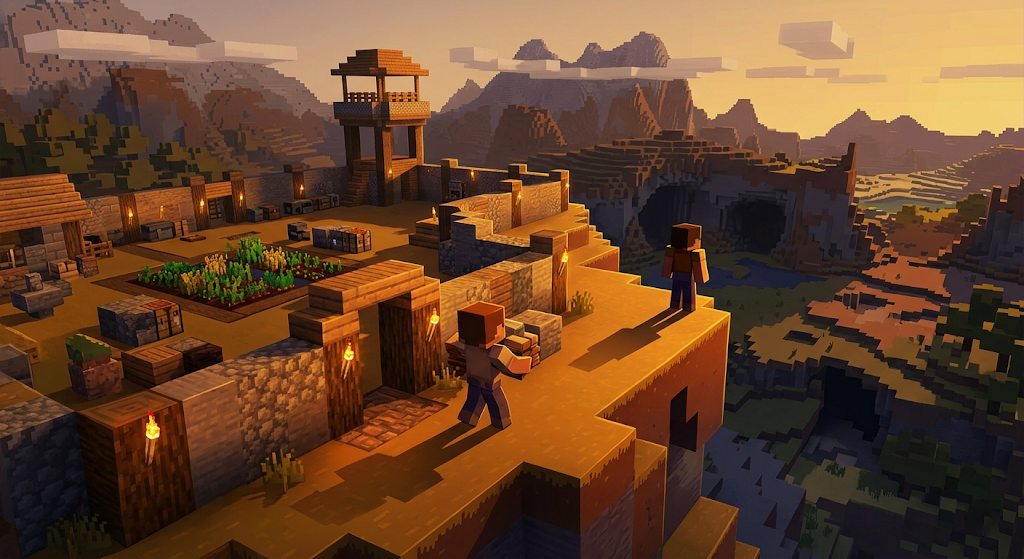
The way you play Minecraft says more about you as a partner than any dating profile ever could. Whether you're the builder, the explorer, or the one who spent three hours digging a hole to nowhere — it all maps somewhere real.
Picture this: you and someone new load into a world together for the first time. Within ten minutes, one of you is meticulously plotting out a starter base — placing every block with intention — and the other has wandered off toward the horizon and hasn't sent a single message. That's not just a Minecraft session. That's already a relationship dynamic playing out in real time, and you didn't even have to go on a date to see it.

The way you play Minecraft — your instincts, your priorities, what you do when there's no objective — is personality data. And personality data is relationship data. The game doesn't tell you to survive a certain way. It hands you an open world and watches what you do with it. Turns out, so does love.
Minecraft has over 140 million monthly active players. The average player is 24 years old. This is not a children's game anymore — it's a massive, adult-skewing world where millions of people spend serious time making decisions about resources, risk, creativity, and cooperation. Those are, incidentally, exactly the skills that make or break a relationship.
So before you write your next bio or swipe on your next profile, it might be worth asking yourself: what kind of player are you?
The Five Types — And What They're Really Saying
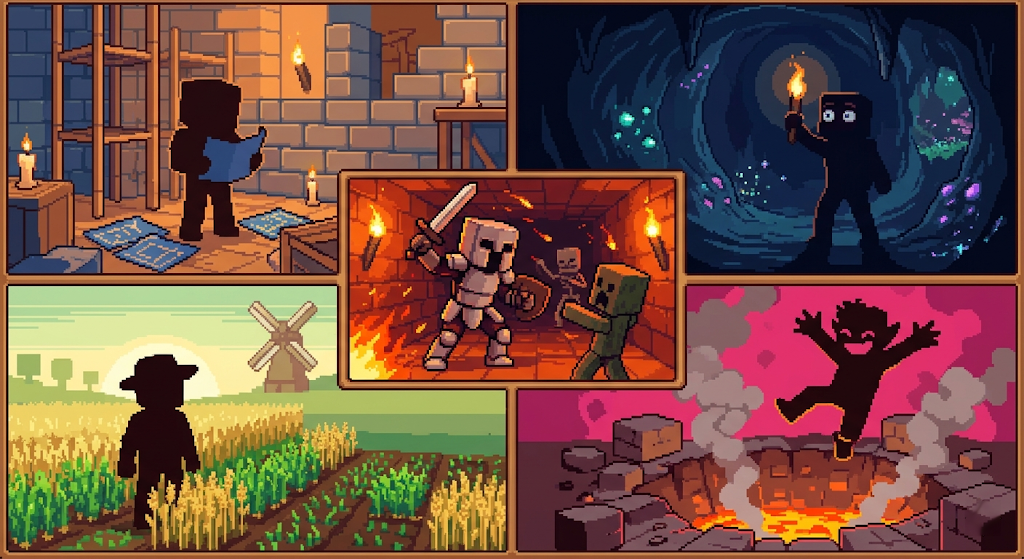
Every Minecraft player eventually settles into a dominant mode — a way of operating that feels natural before the rules even kick in. These aren't random. They map almost perfectly onto how people show up in relationships.
🏗️ The Builder
You have a vision. You always have a vision. The starter hut is never just a starter hut — it's Phase One of something you've already drafted in your head. You don't touch a block without knowing where it belongs.
In a relationship, Builders are deeply loyal and future-oriented. They're the person who already knows what the apartment could look like and quietly starts making it happen. What they need — and often struggle to ask for — is a partner who respects the process. Don't rearrange their build without asking. Don't make major decisions without looping them in. The Builder loves hard, and they'll give you everything they have, but they need to feel like their investment means something to you too.
Research consistently links introversion with deeper engagement in gaming culture. The Builder archetype is where that data lives. Deep loyalty, careful construction, vulnerability disguised as self-sufficiency. Builders pair well with Explorers — someone who brings unpredictability and new energy into what could otherwise become a very quiet, very orderly life. They clash hard with other Builders. Two visions in one house rarely ends smoothly.
🗺️ The Explorer
You have fourteen half-explored caves, zero base, and no regrets. The map keeps expanding, and that's the point. Settling feels like stopping, and stopping feels like dying.
Explorers get misread as commitment-phobic, and that's not entirely wrong — but the real issue is that they haven't found something worth staying for yet. When they do, they stay. They just need a destination that feels as interesting as the journey. In a relationship, they bring spontaneity, curiosity, and an almost annoying ability to find the good in any situation. They also need a partner who doesn't panic when they disappear for a bit — because they'll come back, and they'll usually have something interesting to show you.
Two Explorers together is romantic in theory and a logistical disaster in practice. Nothing gets finished. No base, no plan, no direction. An Explorer with a Builder is the move — one provides the anchor, the other provides the wind.
⚔️ The Fighter / Grinder
You had full iron armor before anyone else built their second wall. You've already mapped the best route to the stronghold. You have a plan, and the plan is efficient, and your time is not a resource to be wasted.
In relationships, Fighters are providers and protectors. They will show up. They will handle it. What they're not great at is reading emotional subtext — not because they don't care, but because they're wired to solve problems, not decipher them. If you're with a Fighter, be direct about your needs. Don't hint. They're not ignoring you; they're waiting for coordinates they can actually navigate to.
Fighter + Builder is a power couple when it's working. Structure meets drive. When it's not working, it's a cold war with very organized shelves.
🌾 The Farmer / Crafter
You have a wheat farm, a cow farm, a sugarcane farm, and you're already planning the automated furnace array. There's no drama in your game. There's barely drama in your life, and that's intentional.
Farmers are the steadiest partners in the room. They show love through acts of service — quietly restocking supplies, making sure everything runs, showing up consistently without being asked. The problem is they're terrible at asking for the same in return. They'll give until there's nothing left and tell themselves they're fine. They need a partner who pays attention to what they're not saying. The person who notices. That's not a small thing.
Farmers are broadly compatible — their stability makes almost any pairing work, at least for a while. Their risk is being taken for granted by Explorers who never slow down enough to notice, or Fighters who assume "fine" means fine.
🔥 The Chaos Gremlin
You dug straight down, found lava, lost everything, and you're already back at spawn with a new plan that is somehow worse than the last one. You're having the time of your life.
Chaos Gremlins are magnetic. They're fun in a way that's almost impossible to explain to someone who hasn't been around it. They also have the planning horizon of a golden retriever. If you're dating a Chaos Gremlin, understand that the spontaneity isn't a phase — it's the whole personality. The question isn't whether you can handle it. The question is whether the moments they create are worth what they definitely don't.
Gremlins need grounding. A Farmer who finds their chaos charming (at least at first) is a solid pairing. A Builder whose carefully designed project keeps getting blown up by a Gremlin is a relationship that has a specific expiration date.
The Science Behind Why This Actually Matters

Here's the part where people expect a punchline, but there isn't one.
A study by IGN Entertainment and Ipsos found that 55% of gamers are married and 48% have kids — and that single gamers are twice as likely to go on dates in a given month compared to non-gamers. They're also 13% more likely to go to the movies, 11% more likely to play sports, and 9% more likely to go out with friends. The "basement hermit" thing isn't just wrong. It's genuinely backwards.
Gaming together, specifically, does something measurable. According to CoupleUni, 67% of long-distance couples who game together report feeling emotionally closer to their partner. Gaming couples reportedly average 8.3 hours of shared activity per week compared to 3.2 hours for non-gaming couples — and some surveys suggest couples who maintain regular gaming routines see meaningfully lower breakup rates.
Dr. Rachel Kowert, a gaming psychology researcher, puts it plainly: shared virtual experiences activate the same neural pathways associated with real-world bonding. The oxytocin is real. The connection is real. The only thing that's "virtual" is the world it's happening in.
Minecraft, specifically, is not a passive game. It demands negotiation, cooperation, resource sharing, and long-term planning — the same skills every therapist will eventually tell you matter in a relationship. That's not a coincidence. It's a feature.
The Compatibility Problem Nobody Talks About

Almost 1 in 3 gamers — 29% — say it's genuinely hard to date non-gamers. For women who game, that number jumps to 40%. And 43% of gamers report that their partners simply don't understand their interest in gaming.
That's not a small frustration. That's a recurring, low-grade disconnection that builds over time. Forty-nine percent of gamers have felt judged by a parent about their hobby. Twenty-eight percent have felt judged by a significant other. More than half — 53% — won't even mention gaming when they first meet someone new. That's a lot of people hiding something they love because they expect it to be met with condescension.
The Minecraft archetypes exist whether you game or not. Everyone's a Builder or a Gremlin in some context. But the beauty of finding a partner who actually plays is that you don't have to translate. They already know what it means that you spent three hours on a build just to tear it down and start over. They've done it. They get it. That shared understanding is not a trivial thing in a relationship — it's a foundation.
Dork Date's Guilds are worth mentioning here, because they're built for exactly this dynamic — spaces where you're already surrounded by people who share your corner of the culture before anyone has to explain themselves.
The Real Test Is How You Play Together

You can know your archetype cold and still have no idea if someone's actually compatible until you're in a world together. That's the variable nobody's charting: how two players interact when they're sharing the same space.
Does the Builder feel supported when the Explorer wanders, or does it feel like abandonment? Does the Fighter's efficiency feel like strength to their partner or like pressure? Does the Farmer's quiet consistency land as love, or does it get invisible over time?
These are the questions the game surfaces faster than almost anything else. Go on a few dates and you get the highlight reel. Load into a survival world together and you get the actual person — how they handle scarcity, whether they share resources, what they do when something goes wrong, whether they check in or go quiet.
There's a reason "play together" has become real relationship advice. It's not about having the same hobby. It's about watching someone make decisions under low stakes and learning everything you need to know before the actual stakes arrive.
Find Someone Who Plays Your Game

The bottom line is this: your Minecraft playstyle isn't a quirk. It's a data point. It tells you how you approach security versus freedom, stability versus adventure, control versus chaos. It tells you what you build when nobody's watching and what you do when things go sideways.
And once you know your type, you can stop wondering why the same patterns keep showing up in your relationships. The Explorer who keeps falling for Builders and then feeling trapped. The Farmer who keeps being taken for granted by Fighters who can't slow down. The Gremlin who keeps making everything harder than it has to be, and somehow charming people anyway.
Knowing your archetype isn't a cure. But it's a start. It's the moment you stop playing on a random server and start looking for someone whose playstyle actually fits yours — someone who builds what you build, or at least comes home to it.
What's your type? Figure that out first. Then find someone who plays the same game.