Convention Dating 101: How to Meet Someone at a Con

Half of all gamers are in relationships with non-gamers. Some of those relationships are great. Here's what separates the ones that work from the ones that don't.
Convention Dating 101: How to Meet Someone at a Con
The Most Obvious Dating Pool Nobody's Using

San Diego Comic-Con draws 135,000 people to a single convention center. Anime Expo has cracked 100,000. On any given weekend across this country, there are hundreds of thousands of people flooding into the same building because they love the same shows, games, and stories you do — and somehow, statistically and absurdly, most of them leave alone.
Not because cons are bad places to meet people. They're actually extraordinary places to meet people. You already know you have at least one real thing in common with everyone in the room. You're all in your element. You're all slightly less guarded than you'd be at a bar or a work happy hour. The conversation excuses are pre-loaded.
The problem isn't the venue. The problem is the approach — or more accurately, the assumption that it'll just happen on its own.
This is for people who go to cons, love them, and still somehow manage to not connect with anyone they'd want to see again on purpose. The mistake isn't hard to make. But it is fixable.
An Eventbrite study of over 2,600 convention-goers found that 65% cite "meet new friends" as a primary reason they attend — ranking it above panels, shopping, and celebrity signings. The gender split has hit near-parity: at cons skewing under 40, women now make up 51% of attendees. Everyone in that building is partly there to meet people. You're not weird for wanting to connect with someone. You're not predatory for noticing that the person in the Cowboy Bebop jacket is attractive.
This is the most socially primed room you will ever walk into.
There's a concept in psychology called the similarity-attraction effect — essentially, that people are significantly more drawn to each other when they share core values and interests. At a con, that baseline compatibility exists before you've said a single word. You can literally see someone's personality from twenty feet away based on what they chose to wear, what merch they're carrying, what panel room they're heading toward. The homework is already done.
Most people use none of this. They attend with their existing group, stick with their existing group, and treat meeting new people as something that might just happen rather than something to actively attempt.
The Introvert Majority
Here's a detail worth sitting with: 56.8% of people globally test as introverted on MBTI assessments. Con-going populations skew even further in that direction. So you have a building full of people who are genuinely bad at cold approaches in normal social contexts — who have been handed an environment that removes every awkward part of cold approaches.
No "why are we talking?" ambiguity. No "are they open to being approached?" puzzle. You're at a con. Everyone already opted in. That's not a minor advantage. That's a fundamental restructuring of the social contract, and most introverts aren't using it.
The Con Bubble Will Lie to You
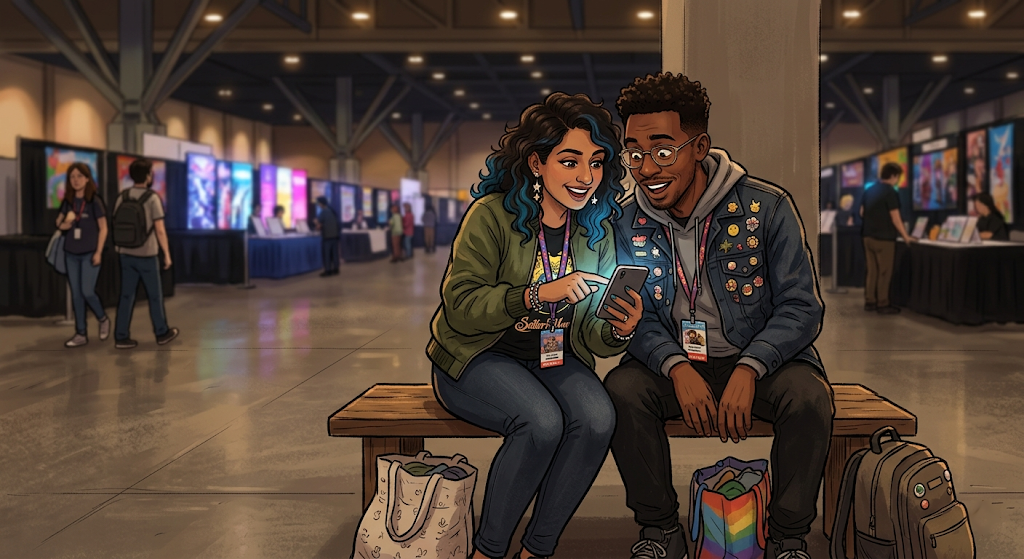
Let's talk about the con bubble, because it's the part nobody explains and it will absolutely wreck your perception of what happened if you're not ready for it.
Over 2-4 days at a convention, something weird happens. You meet someone, you spend hours together wandering the exhibit floor and waiting in panel lines and hunting for food at midnight. By Saturday night you feel like you've known them for weeks. By Sunday you're quietly wondering if this is the person.
The con bubble is real. It's created by time compression — you're cramming what would be two weeks of normal social interaction into 72 hours. Shared peak experiences (the sold-out screening, the cosplay contest, the adventure of getting vaguely lost in the wrong hotel tower) create emotional memories fast. Sleep deprivation and general excitement lower inhibitions. And there's a subtle urgency running underneath all of it: everyone knows this ends Sunday.
The problem is that the bubble inflates things, and it doesn't tell you it's doing it.
What's Real, What Isn't
Genuine shared interest? Real. The fact that you both know every detail of the same fictional universe and can talk about it for three uninterrupted hours? That's actual compatibility data. Don't dismiss that part.
The sense of profound intimacy you feel by Saturday night? Worth some skepticism. You're running on adrenaline and convention hall energy. The feeling that you've found someone who truly gets you, after 18 hours of knowing them, is partly real and partly the con doing its job. It's valuable — but it's a starting point, not a conclusion.
The people who handle con connections well are the ones who treat the bubble as a strong first chapter, not a whole story. You made a real connection. Now you have to find out if it survives contact with Tuesday.
The Tell
The simplest test: are you excited about this specific person, or about the version of yourself that exists at cons? If you felt like your most authentic self this weekend — open, expressive, genuinely present — that's the con doing its job. That feeling is worth protecting. A real connection is one where you want to bring that version of yourself into the other person's everyday life, not just the next convention.
Most con romances don't fade because the chemistry was fake. They fade because two people who lived in different cities shared a very good weekend and didn't build anything beyond it. That's a logistics problem, not a compatibility verdict.
Where to Actually Find People
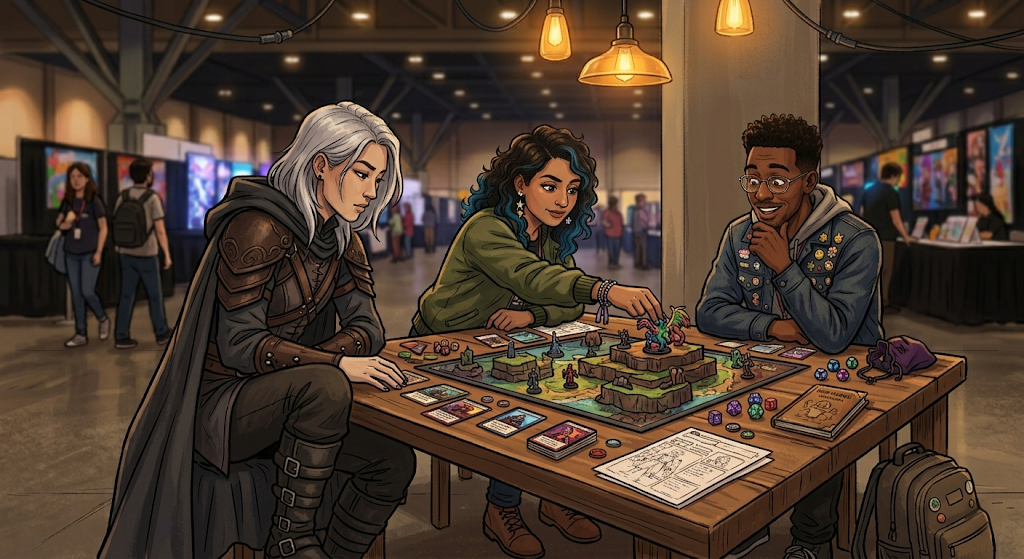
The main convention floor is the worst place to try to meet someone. It's loud, everyone's in transit, and the crowd is too dense for actual conversation. You're essentially trying to have a meaningful interaction in the middle of a busy city block.
The places that actually work tend to be quieter and more specific.
Smaller Events Within the Con
Gaming rooms. Fan meetups. Cosplay gatherings organized around a specific property. Panel Q&As. These are where people sit down, stay in one place, and are actually present for more than ninety seconds. Shared interest is also narrowed further here — you don't just both love anime, you both love this anime enough to be in a room about it at 11am on Saturday. That's information.
Board game and tabletop areas deserve specific mention. Research on gaming couples found that those who play together at least once a week report double the net relationship satisfaction compared to couples who rarely or never play together. There's a reason for that: cooperative gaming teaches you how someone handles stress, setbacks, and collaboration. When you sit down to play a game with a stranger, you learn more about them in two hours than you would across four dinners.
And for what it's worth, 56% of gamers now view their gaming communities as legitimate potential dating pools. The tabletop room is not an unusual place to be looking. It's probably the best place to be looking.
Solo Time
If you want to meet someone new, you need windows where you're actually approachable — which means windows where you're not enclosed by your existing friend group. Not all weekend. But some of it. Friend groups create closed energy that reads as "we're full" from the outside. Spend some time wandering on your own. Sit somewhere open. Let things develop without your whole crew watching.
Going to a con solo, or breaking off from your group for a few hours, radically changes your chances. This is not about abandoning your friends. It's about giving strangers a reasonable entry point.
What to Actually Say
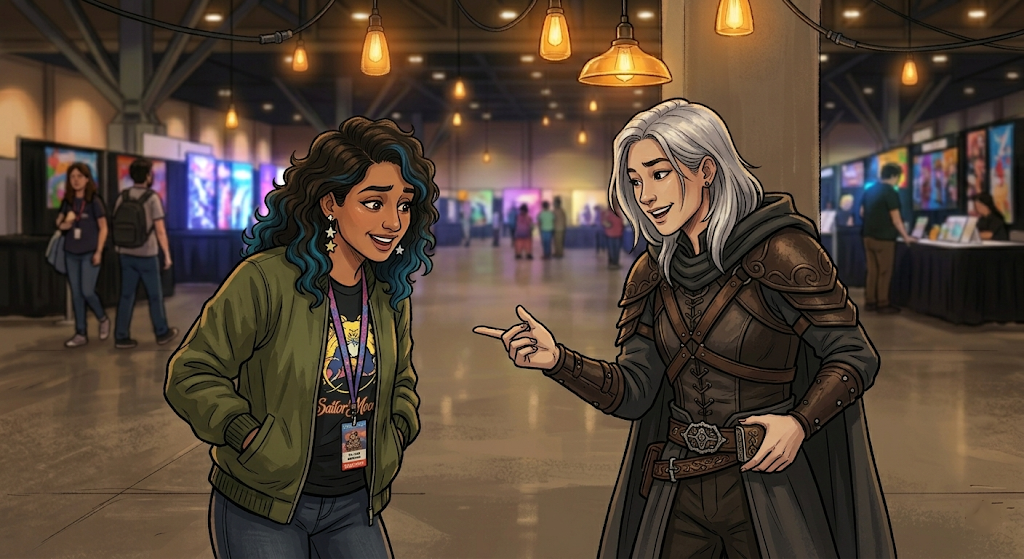
Cosplay is the greatest icebreaker in the history of human social interaction. "I love your build" or "Who are you supposed to be?" (for the more obscure choices) is a universally understood, socially sanctioned invitation to talk. Everyone who cosplays knows this. Everyone who receives it appreciates it when it's genuine.
Use it. But don't stay there.
The mistake most people make is camping in fandom trivia mode. Shared love of an IP is a door, not a room. "What's your favorite arc?" is fine. "What drew you to this character specifically?" is better. You're looking for the person underneath the cosplay, not just the cosplay itself. The goal is a real conversation, not a pop quiz.
Reading the Room
Signs someone wants to keep talking: they ask you something back, they lean in rather than look away, they introduce you to whoever they're with. Signs they're wrapping up: short answers, eyes drifting, body pivoting away. Con culture has made most attendees very practiced at polite, non-confrontational deflection. When someone is being politely distant, take it at face value and move on. There are tens of thousands of other people in the building.
Women at cons, in particular, are often guarded by necessity rather than disinterest — informal surveys have documented that as many as 1 in 4 women experience some form of harassment at cons. That context matters. If an approach isn't landing, it's not personal. Take the cue, exit gracefully, and let that be the end of it.
The One Thing Not to Do
Don't assume cosplay signals availability or interest in you specifically. Someone dressed as a fan-favorite character is performing an expression of identity, not advertising anything. The costume tells you they love this character, this world, this craft. That's useful information. What it's not is an invitation. Read the person, not the character.
The Move Nobody Makes: Following Through

Here is the single most common con dating mistake: making a genuine connection and then not getting contact information.
It sounds obvious. Do it anyway, and do it before you separate — not after you've wandered off assuming you'll find each other again on the floor. You won't. The building holds 50,000 people and the exhibitor hall has the spatial logic of a fever dream.
Get Instagram, Discord, a phone number — whatever makes sense in the moment. Get it before you part ways. And when you do it, attach something concrete: "I'll DM you about that panel tomorrow" or "We should actually finish that game — are you around Sunday morning?" A specific next step beats "we should hang out" by an enormous margin. "We should hang out" is a polite goodbye. A specific plan is an actual plan.
If you're meeting people at cons but the connection doesn't survive the drive home, Dork Date's Guilds are built for exactly this — interest-based communities where you can stay in contact with people from your fandoms without waiting for the next con to pick up where you left off.
After Sunday
Make contact within a week. Not "see you at the next con in six months" — that's a warm goodbye, not a follow-through. An actual message. A video call. Something that establishes whether what you felt survives the return to normal life, where you're not running on convention adrenaline and you each have jobs and commutes and all the usual friction of being a person.
Most con connections don't get this far. The ones that do have a real shot. That's not a romantic exaggeration — it's just math. The con does the hard work of establishing shared interest and initial chemistry. The only thing left to do is find out if two people are willing to put in the very modest effort of staying in contact. Most don't. That's the whole reason this is worth writing about.
78% of daters report feeling emotionally exhausted by apps. 60% find online dating completely overwhelming. Meanwhile, every weekend somewhere in this country, there's a building full of people who have watched the same obscure thing six times and are actively hoping to meet someone who has too. The highest-friction part of attraction — figuring out if you have anything real in common — is handled before you say a word.
Go to the Con. Actually Talk to People.

Nobody's promising you a love story by Sunday. The con is not a guaranteed outcome and treating it like a dating-specific mission is one of the fastest ways to make it weird for everyone, including yourself.
But it is one of the only environments where the hardest parts of meeting someone are already handled — the "do we have anything in common" question, the "is this even someone I'd want to talk to" question — before you've opened your mouth. That's genuinely rare. Most places you go, you're starting from zero. At a con, you're starting from a base of shared identity that took years to develop.
Show up. Spend some time on your own. Go to the smaller events — the gaming rooms, the fan meetups, the panels for things you actually care about. Get the contact information before you wander off. Follow up within a week with something specific.
That's the whole guide. Everything else is just doing it.